
E-Commerce Accounting & VAT: Challenges, Business Types, and Solutions
Introduction
The e-commerce industry is one of the fastest-growing sectors globally, driven by the shift towards digital shopping, greater internet penetration, and changing consumer habits. Selling online offers unmatched opportunities — global reach, 24/7 accessibility, and low entry barriers. However, with these opportunities come significant operational, financial, and regulatory complexities. From managing multi-channel sales to dealing with VAT obligations in multiple countries, business owners face an complex landscape.
Whether you’re running a small home-based store or managing a multi-national online retail operation, getting your accounting, bookkeeping, and VAT compliance right is critical for avoiding penalties, making informed decisions, and sustaining profitability.
In this guide, we will explore:
- The biggest challenges online sellers face in today’s market
- The different types of e-commerce business models and their unique issues
- Accounting and VAT implications that every seller must understand
- Our expert solutions that help streamline and simplify financial management
Types of E-Commerce Businesses & Their Accounting Problems
Dropshipping
Dropshipping allows sellers to list products without holding inventory, with the supplier shipping directly to the customer. While it removes the need for warehousing, it comes with challenges such as matching supplier invoices to customer orders, tracking shipping costs accurately, and determining VAT obligations when goods are shipped internationally. Margins can be slim, so even minor accounting errors can lead to losses.
Solution: Implement automated order-to-invoice matching systems, apply the correct VAT rates based on customer location in real time, and track margins after all supplier and platform fees.
Private Label / Own Brand
Private label businesses develop or source products under their own brand name. This model often involves importing goods, which brings import VAT and customs duties into play. Managing inventory valuation and separating wholesale from direct-to-consumer sales is crucial for understanding profitability across different sales channels.
Solution: Integrate your accounting with inventory management software, accurately track import VAT for reclaim, and produce segmented reports for wholesale and retail operations.
Marketplace Sellers
Selling on platforms such as Amazon, eBay, or Etsy gives you access to large customer bases, but also means dealing with platform-specific fees, refunds, advertising charges, and marketplace VAT collection rules. Sales data is often fragmented across platforms, making consolidated reporting essential.
Solution: Use multi-channel integration tools to consolidate reporting, provide transparent breakdowns of fees and refunds, and automate VAT calculations for marketplace transactions.
Subscription-Based E-Commerce
This model involves selling recurring products or services, such as monthly subscription boxes or software memberships. The main accounting challenge is recognising revenue correctly over the subscription period, especially for prepaid plans. Managing churn (customer cancellations) and distinguishing VAT rates for digital vs. physical products adds complexity.
Solution: Implement deferred revenue accounting, track churn rates closely, and categorise VAT correctly for all subscription products. Keep track of subscription payments so that the money you get in advance is only counted as income when the customer actually receives the product or service. Monitor how many customers cancel so you can spot problems early, and make sure you charge the right tax for physical items versus digital products.
Common Challenges for E-Commerce Businesses
Fierce Competition & Customer Expectations
With e-commerce, you are competing not just with local businesses but with global brands that often have bigger budgets, more resources, and advanced logistics. Customers now expect next-day delivery, free returns, and consistent product quality. Meeting these expectations requires operational efficiency, strong supplier relationships, and clear financial planning to avoid eroding profit margins.
Inventory & Supply Chain Complexity
E-commerce often involves selling across multiple platforms such as Amazon, Shopify, eBay, and Etsy. Managing stock across these channels can be complex, especially when inventory is held in different warehouses or even countries. Overstocking ties up cash flow, while understocking results in missed sales opportunities. Poor inventory control also makes accurate cost-of-goods-sold calculations more difficult, which directly impacts profitability analysis.
Multi-Channel Sales Data Overload
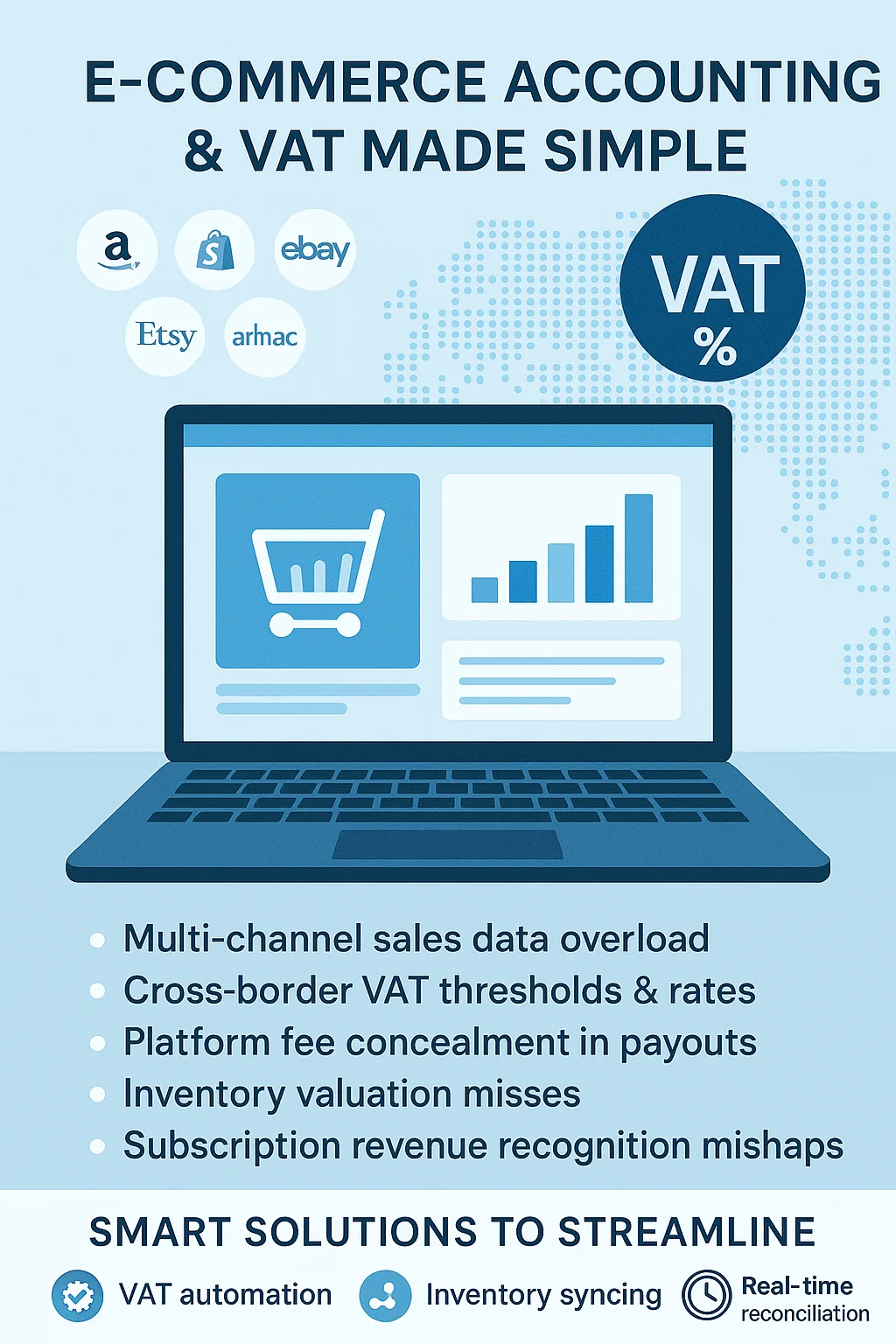
Each marketplace or sales platform has its own reporting system, often with different data formats and timeframes. Manually consolidating this information for accounting purposes can be time-consuming and error-prone. Without a proper system to merge and reconcile this data, financial statements may be inaccurate, leading to poor decision-making.Every sales platform — Amazon, eBay, Etsy, Shopify, Walmart, and others — has its own reporting system with unique formats, metrics, and timeframes. Amazon’s 14-day settlement cycles, Shopify’s real-time sales updates, and eBay’s monthly statements rarely align. Consolidating these mismatched reports manually is slow, error-prone, and risks producing inaccurate financials.
Cross-Border Trade & VAT Rules
Selling internationally opens new revenue streams, but it also exposes you to various VAT/GST thresholds, rates, and filing requirements. For example, the EU’s One-Stop Shop (OSS) rules allow centralised VAT reporting, but you still need to track sales per country to remain compliant. Additionally, currency fluctuations can affect profitability when converting sales revenue back to your home currency.
Payment Processing & Currency Fluctuations
Different payment processors charge varying fees, which can be difficult to track manually. Settlements may take days or weeks to appear in your bank account, and amounts received are often lower than expected after deductions. For sellers operating in multiple currencies, exchange rate movements can significantly impact both cash flow and profit margins.
Accounting & VAT Implications
Revenue Recognition & Fee Deductions
In e-commerce, the amount deposited in your bank is often not your actual sales revenue due to platform fees, advertising costs, or refunds being deducted before payout. Without tracking gross sales and associated deductions, you risk underreporting income and miscalculating profitability.
Expense Tracking & Categorisation
Accurate expense categorisation is essential for understanding where your money is going. Common costs include online advertising, transaction fees, fulfilment costs, and software subscriptions. Poorly categorised expenses can distort your profit and loss statements and make tax filing more complicated.
VAT Compliance Requirements
Domestic VAT registration is required once you exceed your country’s turnover threshold. In the EU, the OSS scheme allows sellers to declare all cross-border sales in a single VAT return, but correct setup and record-keeping are essential. For marketplace sales, some platforms collect VAT on your behalf, but you must still maintain accurate documentation.
Common VAT Mistakes
- Missing VAT registration deadlines in foreign markets
- Charging incorrect VAT rates for different product types
- Failing to reclaim input VAT on eligible purchases
Our E-Commerce Accounting Solution
Multi-Channel Integration
Our team of experts offer a bespoke solution to account for transactions from all major e-commerce platforms like Amazon, Shopify, Etsy, eBay, and so on. Our solution pulls sales, refunds, and fees into one unified dashboard, eliminating the need for manual data entry.
Real-Time VAT Management
We track sales by country and alert you when you approach VAT thresholds. The system automatically applies the correct VAT rates based on customer location, reducing compliance risks.
Automated Bank Reconciliation
Our solution matches payouts to individual orders, factoring in platform fees, refunds, and currency conversions. This ensures accurate cash flow tracking and financial reporting.
Inventory & COGS Tracking
We help maintain accurate inventory records and calculate the cost of goods sold, so you can make informed pricing decisions and improve profitability. We utilise the inventory management systems provided by the marketplaces and conduct regular reconciliations to ensure that recorded stock levels align with the actual physical inventory.
Expert Support
Our team consists of e-commerce accounting specialists who understand platform-specific rules and can advise you on tax efficiency, compliance, and scaling your business.
Conclusion
Success in e-commerce is about more than just selling — it’s about managing your operations, finances, and compliance with precision. By implementing the right accounting systems and VAT processes, you can avoid costly mistakes, free up time, and focus on growing your store.
Let us handle the numbers while you concentrate on building your brand.
Related Playbooks & Articles
Ready for senior finance leadership on your terms?
Book a confidential 15-minute consultation with us to benchmark your month-end speed, cash runway, and board packs.